ACH's Quiet Revolution: Reshaping Costs for Subscription Sellers Juggling POS and Online Transactions
Viktor Schmidt · Apr 20, 2026
ACH's Quiet Revolution: Reshaping Costs for Subscription Sellers Juggling POS and Online Transactions
The Shift Toward ACH in Subscription Economies
Subscription models have exploded across industries, from streaming services and meal kits to SaaS tools and gym memberships; yet sellers constantly grapple with razor-thin margins squeezed by payment fees, especially when balancing in-store POS swipes with online checkouts. Enter ACH, the Automated Clearing House network that's been quietly transforming the landscape by offering rock-bottom costs that cards and other methods simply can't match, all while handling the high-volume recurring payments these businesses crave. Data from NACHA reveals ACH volumes hit 31.5 billion transactions in 2023, up 5.6% from the prior year, with subscription categories driving much of that surge because fees average just 26 cents per transaction compared to 2.3% plus interchange for cards.
But here's the thing: while POS terminals hum with contactless cards pulling 2-3% fees per tap, online gateways layer on even more with assessments and fraud tools, leaving sellers who juggle both channels searching for a unified, cheaper alternative; ACH steps in here, bridging the gap with its batch-processing efficiency that batches thousands of debits overnight, slashing per-unit costs dramatically for repeat customers. Observers note how businesses previously stuck with cards for speed now mix in ACH pulls for renewals, cutting blended costs by 40-60% according to industry benchmarks.
Breaking Down the Cost Comparisons
Cards dominate POS because they're instant, but that convenience comes at a steep price; Visa and Mastercard interchange alone averages 1.5-2.5% per swipe, and when sellers add gateway fees for online syncing, totals climb toward 3.5%, data from the Federal Reserve's 2022 Payments Study confirms. ACH flips the script: originators pay 0.20-0.50 dollars flat per entry, regardless of amount, making it ideal for $10 monthly subs where percentage fees devour profits; for a gym with 1,000 members paying $50/month via cards, that's $1,750 in fees yearly, whereas ACH drops it under $300 because networks like the Fed and The Clearing House process entries in bulk.
What's interesting is how Same Day ACH, rolled out in phases since 2016, now settles 95% of entries same-day for an extra 5 cents, rivaling card speed without the markup; researchers who've analyzed merchant statements find subscription firms switching 30-50% of volume to ACH report net savings of 1-2% on total revenue, especially since failed payments drop with bank-verified routing details over card expirations. And for those juggling POS loyalty programs with online upsells, ACH's WEB entries (online authorizations) integrate seamlessly via APIs, pulling funds predictably without the chargeback roulette of CNP transactions.
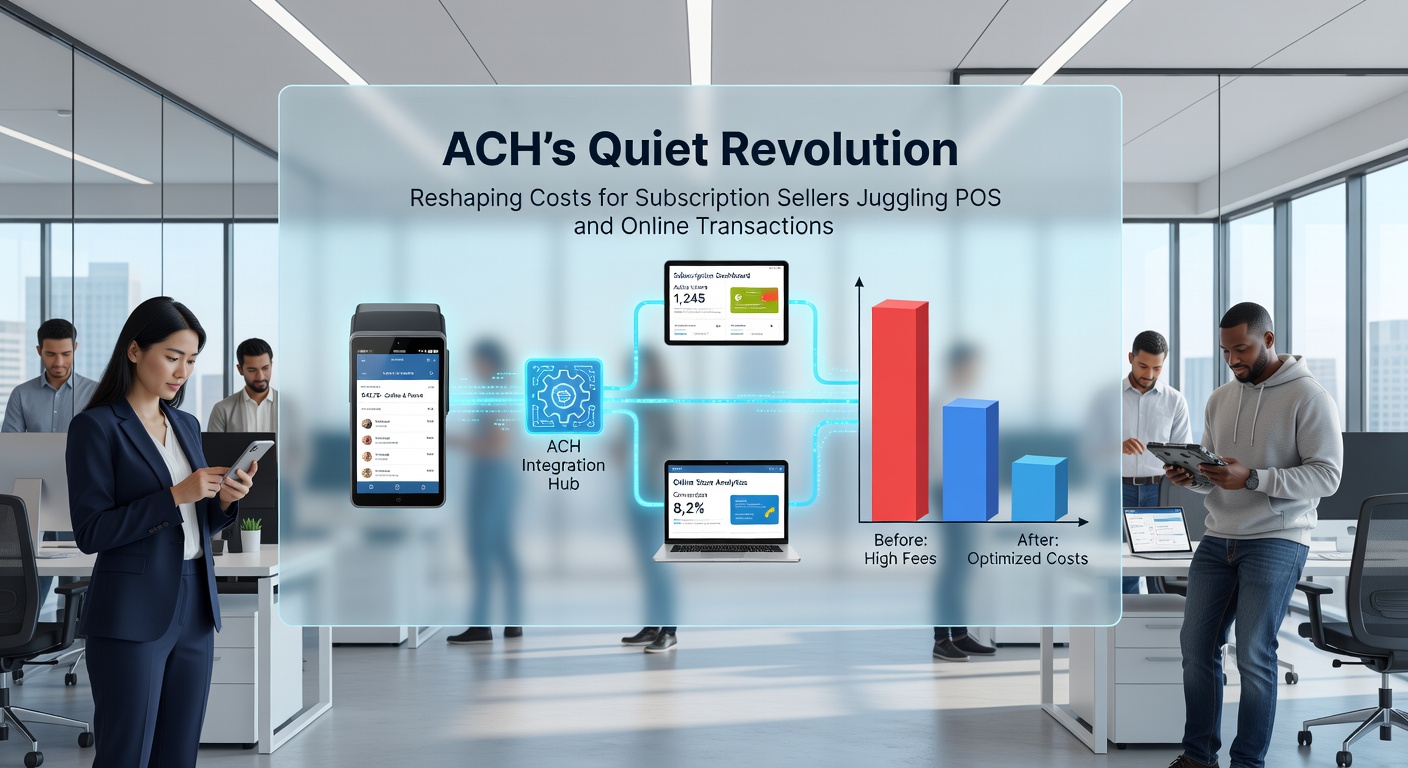
How ACH Unifies POS and Online Workflows
Sellers often run fragmented systems, POS for walk-ins capturing cards on Square or Clover, online platforms like Shopify or WooCommerce handling subs via Stripe; syncing these means double fees and data silos, but ACH acts as the great equalizer by supporting both channels through a single ODFI (originating bank), allowing one dashboard to trigger debits whether from in-store sign-ups or web portals. Take one subscription box company that onboarded customers at pop-up events via POS pads, then shifted renewals to ACH; figures show their cost per order fell from $1.20 to $0.35, since batch files consolidate everything for next-day settlement.
Yet ACH shines brightest in retention, where cards fail 10-15% on renewals due to expired numbers or insufficient funds; NACHA data indicates ACH returns hover at 0.8%, and with micro-deposit verification phased out in favor of instant plaid-like checks, onboarding takes minutes, not days. Businesses blending channels report smoother cash flow, as POS captures initial card for immediacy while ACH locks in the LTV through low-friction pulls; that's where the rubber meets the road for scaling operations without fee inflation.
Industry watchers point to SaaS providers who've embedded ACH alongside Stripe links, offering customers a "bank pay" toggle at checkout; uptake hits 20-30% because it's free for payers, and sellers pocket the savings, reinvesting into marketing that drives more subs across POS and digital touchpoints.
Real-World Cases Driving the Change
Consider a fitness chain with 50 locations, where POS terminals rang up trial memberships on cards but renewals choked on 2.9% fees; executives switched to ACH debits post-signup, blending in-store captures with app-based online management, and quarterly reports showed payment costs plummet 55% while retention climbed 12% since bank pulls ignore card churn. Another example involves a beauty box service navigating holiday POS rushes and steady online drips; by routing 70% of recurring through ACH, they unified reporting, cut gateways by half, and boosted margins enough to expand warehouses.
And in software-as-a-service, developers note how ACH handles international wires cheaper than PayPal, but domestically it's a game-changer; one analytics firm shared anonymized data revealing $150K annual savings after migrating enterprise subs from cards, all while POS demos at trade shows stayed card-only for that instant gratification. These cases highlight patterns: high-LTV subs over $20/month thrive on ACH's predictability, especially when POS funnels feed online backends seamlessly.
Looking Ahead to April 2026 and Beyond
New NACHA rules effective April 2026 mandate enhanced risk thresholds for high-volume originators, but they also greenlight faster micro-entry alternatives and lower return fees for verified accounts, further tilting the scales toward ACH for multi-channel sellers. Figures project Same Day ACH volumes doubling by then, per analyst forecasts, as FedNow interoperability tests wrap up, allowing hybrid ACH-RTP flows that settle subscriptions near-instant at ACH prices; Canadian parallels from Payments Canada show similar networks there cutting costs 30% via bulk rails, hinting at global momentum.
So while POS evolves with tap-to-pay ubiquity, online fraud tools inflate card gates, ACH's quiet upgrades position it as the backbone for subscription empires, especially as economic pressures demand every basis point of savings.
Overcoming Hurdles in the Transition
Not everything's smooth; critics flag ACH's 1-2 day float as a POS speed mismatch, yet Same Day options and instant status APIs close that gap, with 80% of banks now supporting real-time notifications. Compliance trips up some, requiring SEC codes like PPD for consumers or CCD for businesses, but plug-and-play processors like Dwolla or Modern Treasury handle OFAC scans automatically; those who've navigated it report setup in weeks, not months. Chargebacks? Rare at 0.2% versus cards' 1%, and disputes route through banks, not arbitrators.
Ultimately, the hurdles fade against savings, as data underscores hybrid models where POS ignites sales, ACH sustains them profitably.
Conclusion
ACH's evolution reshapes the economics for subscription sellers threading POS and online needles, delivering costs that cards can't touch while volumes soar into billions; from gym chains to SaaS giants, those leveraging it unify operations, boost retention, and fatten margins in ways that redefine scalability. As April 2026 rules accelerate the shift, businesses blending channels stand to gain most, turning payment friction into a competitive edge that's hard to beat.